In 1870, Eley age 30: Post Office in Jerusalem, Franklin Depot. (Farmer, Postmaster?)
In 1874, an Eli Bryant was listed as a member of Mount Carmel Christian church in Isle of Wight County. (see record attached to Eley in Ancestry). Follow up on this by locating the book Joyner of Southampton by Ullyses S. Joyner at the Library of Virginia. (See 1883 below).
1880
In 1880, Eley and Margaret lived in Franklin.
Margarett [sic] b. 21 Oct. 1880; d. 20 Aug 1881 in Southampton County.
Ida's 1st marriage according to the 1930 U. S. Census was at age 16. No other evidence of this marriage has been found, but it does suggest that Ida had told someone about a marriage in her teens. In the 1910 U. S. Census, she only admitted to two marriages, including George Abbott.
1886
Eley and Margaret sold the farm (85 acres) in Southampton County on 7 Jan. 1886 to J. B. Prince (no re-sale for three years; released 9 Jan. 1888).
Fenton Bryant b. June 1886 in Princess Anne County; d. 10 Mar 1887. Eley and Margaret had not yet purchased the Blackwater farm. Did they perhaps rent property in PA County after the sale of their land in Southampton County?
1887
Ida m. Lewellyn Eley on April 13 at age 19 in Southampton County. Her parents had already moved to Princess Anne County. [Marriage register #6 1886-1890 Southampton County p. 184.]
1888
Eley and Margaret purchased the "Young Tract" in Blackwater. 42 Acres, "give or take" for $425. 3 Feb 1888. Deed for Johnston G Forbes and Margaret F. Forbes to Ely Bryant (Princess Anne County Deeds, book 59, pp 364-367. Deed of Trust held by JM Keeling. Transcribed by Matt Weismantel Aug 2021). Eley and Margaret moved to Princess Anne County before the Fletchers did.
Eley and Margaret lived in Princess Anne County at "Land of Promise" Plantation (a bit of exaggeration here), growing cotton, tobacco, and peanuts. (Source?) Their farm was at the "T" intersection of Blackwater and Head of River Roads. It was 42 acres according to probate documents obtained at the Library of Virginia. A major source of income was lumber.
UPDATE 9/20/21: The property that Charlie Fletcher originally identified as the Bryant farm was in error. Today, I used the legal description of the property in the original deed record to confirm the location, and found that the farm was actually across S. Head of River Road, on the other side of the Cox farm. This upset some of our major assumptions, and it now leads our search for Margaret and Eley’s graves in a whole different direction.
Here is a map showing the property, sold to Eley by Johnston Forbes in 1888. This location perfectly matches the description in the deed of trust. [This map is on the Virginia Beach public library website, and is attributed to the year 1930 though it contains dated information].
UPDATE: 9/23/21: Cousin Terry and I drove out to Blackwater to scope out this newly discovered Bryant Farm. The boundaries of the original farm are easy to see, but it is all now a field where it once had been woodland. The field is nothing but soybeans as far as the eye can see. There is no indication of an old homesite or of any signs or markings of graves. We did find a map, however, that showed a house on the property... just a dot indicating its location:
Near the bottom of the map below the circled area, see the number 11 at the corner of the intersection. That is the location of the Bryant farm. You can see a small dot below the 11 indicating a house that was there in 1992 when this map was created by the City of Va Beach Planning Commission. If you look at the map above this one, the dot next to the name "Johnston Forbes" is in the same location.
1888, continued...Addie married Blucher “Bluker” Fletcher on March 7. They ran a store in Woodville, NC for a time afterward.
1893
[Ida's ex-husband, Lewellyn Eley m. Sallie Ann Jones in Southampton County on Jan 11, 1893. Lewellyn went on to have a large family and lived in Norfolk]. Was his marriage to Ida annulled or did they divorce?
1890s
Blucher and Addie purchased the Blackwater farm from Mr. Baum. What date?
 |
| The Fletcher farm today |
 |
| An old tree that marked the original home site died and has fallen over. |
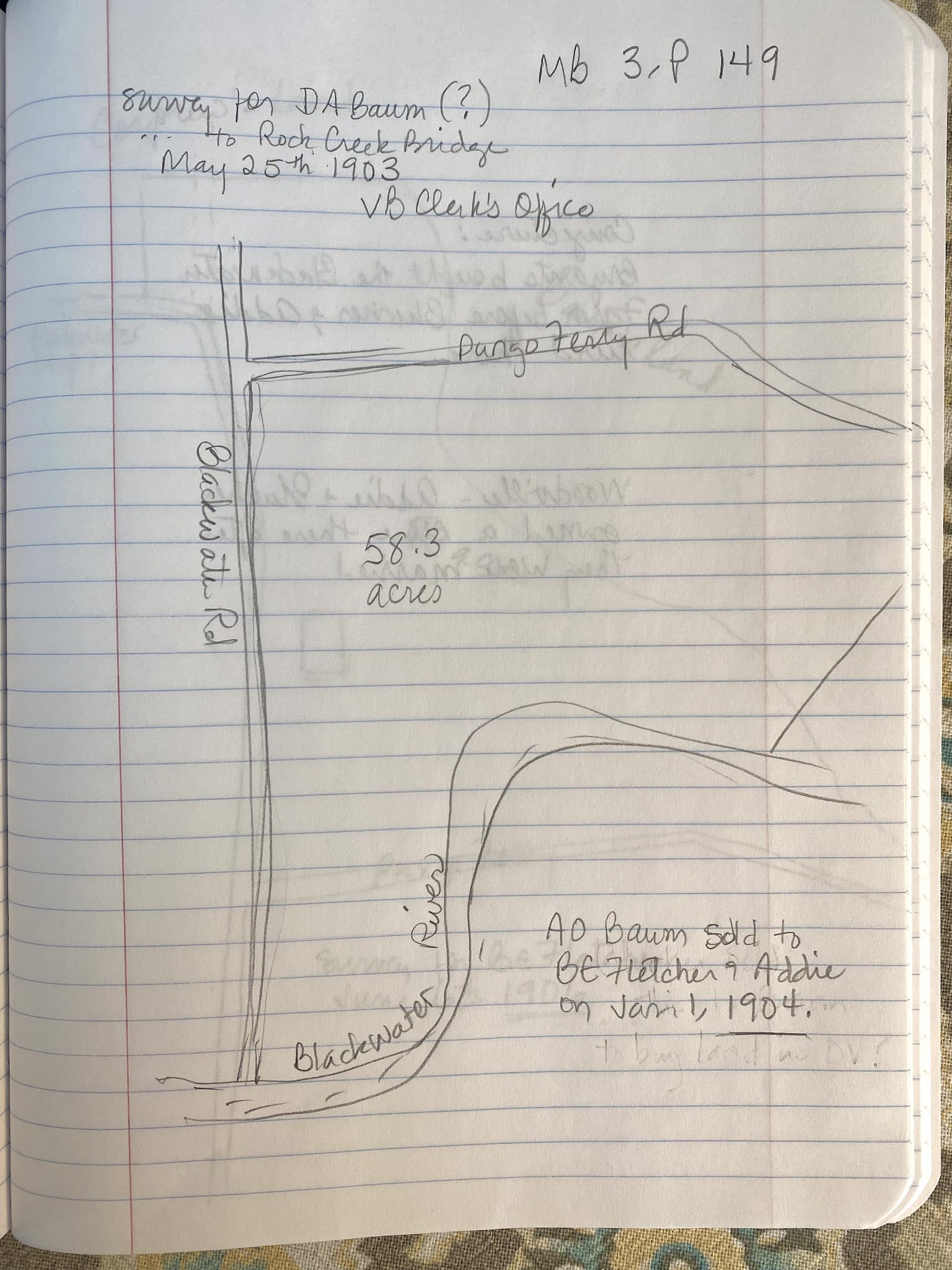
Blucher and Addie’s farm was just down the road from the Bryant farm. We found surveys of the Fletcher property at the VB Courthouse, showing that the farm was purchased in two stages. The first part of the farm, 75 acres on the north side of Pungo Ferry Road, was purchased [c1890] from Mr. Baum, who kept the land from the tree line back to the North Landing River. The second part of the farm was purchased in 1904 from Mr. Baum, 58.3 acres on the south side of Pungo Ferry Road. At the time, Blackwater Road turned left almost at a 90-degree angle at what is now Blackwater Loop. Part of the Fletcher farm is under the present-day Blackwater Road on the north end of the property.
Below are rough drawings based on property surveys from the Virginia Beach Courthouse:
 |
| When was this parcel originally purchased? |
 |
| Purchased in 1904. |
189?
Ida married ___ Williams. No marriage record in Southampton County. By 1895, "Ida (Bryant) Williams" was widowed and living in Princess Anne County. (See 1895 marriage license to William Butler).
Was Ida's 2nd husband a "Williams" of PA County? Ida is named "Ida Williams, widow" on her Princess Anne County marriage license to William Butler in 1895. Was she living with Eley and Margaret? (This is where the 1890 US census would have been helpful). Ida never mentions this marriage or her marriage to Lewellyn Eley to her children.
NOTE (9/9): a search of marriage records at the Library of Virginia yielded no results for "Ida Bryant," or "Ida Williams. Her marriage to L.P. Eley is recorded for 1887. A search for [husband] Williams for the years 1884-1899 showed a "Jesse Williams" who married "Ida Major" in 1884 in Norfolk County, and a "Geo H. Williams" who married "Ida Butler" in 1888 in Norfolk City. These records require some follow up. Those last names don't fit Ida's currently-known profile, but might possibly indicate a last name of a husband as yet to be discovered.
189?
Ida’s husband __Williams died.
1892
Ida's son Earl b. 18 Nov. 1892 where? Who was the father? Is is possible to get Earl's grandson Scott to check his DNA link to William Butler and to ___ Williams?
1895
Ida m. William Butler on 17 Jan. 1895. "Ida Williams, widow." Marriage license in Princess Anne County 17 January 1895. Marriage took place in Norfolk Virginia.
Ida's son William Brown Butler Jr was born in Oct 1895 in Lynchburg.
Eley died in Princess Anne County at the age of 66 on Dec 15, 1895.
Margaret did not report Eley's death. This enabled her to continue to live on the Blackwater farm and collect income. If she had reported Eley's death, the farm would have to be divided - 1/3 for Margaret; and 2/3 to be split among her children. This would mean that Margaret would have to sell the farm, which she did not want to do.
1897
Ida's son Rawley Butler b. Nov 1897 in Lynchburg. Was he really Ida's son? See notes under 1900.
1900
William T. Bryant m. Rebecca "Bonnie" Abbott (George Abbott's half sister) at the Queen Street Methodist Church parsonage on 15 Jan. 1900 in Norfolk, Va.
In the 1900 U. S. Census, Addie and Blucher lived in Princess Anne County.
In the 1900 U.S. Census (June), in Lynchburg, Ida has only TWO living children (all three are listed as William Butler's sons). NOTE: Earl's grandson has been linked to me by DNA, so Ida is definitely his mother. Is Earl the son of Ida's previous husband? If so did William Butler give Earl his last name legally? It is assumed that William Brown Butler (Jr?) is also her son, considering that he was born exactly nine months after her marriage to William Butler in 1895. There was a servant named Susan Austin, age 23, living with them in 1900. Could Rawley be Susan's child? I have contact info for a grandson of Rawley's... perhaps he did a DNA test..? This would explain why William's obit (1904) says he has only one son, presumably William Jr.
In 1900, Margaret, a widow, lived in Pungo, Va. (Princess Anne County), with William Bryant and his wife Rebecca “Bonnie.”
Around 1900-1901, William and Bonnie moved back to NJ, and Margaret moved to Richmond to live with Ida.
When Margaret went to live with Ida in Richmond, she rented out the Blackwater farm for $50 a month. Her youngest daughter Gattie Jane held the bond for the property. (Per probate papers from 1908 court case).
1904
Blucher and Addie purchased the 2nd parcel of land at Pungo Ferry Road from Mr. Baum. 1 Jan. 1904.
William Butler died in Lynchburg, Va. 1 Aug. 1904. (His obit says he was survived by one son). All 3 boys were placed in an orphanage in Richmond.
Ida m. George Abbott. 17 Dec. 1904. in Norfolk, Va. She was 36, he was 21. Family lore says that Ida met George when he was just a boy in NJ. Why did Ida move to Richmond? to be near her sons? To my knowledge, there were no other family connections in Richmond. Apparently her sons were placed in an orphanage in Richmond after William Butler died - not unusual for a widowed parent (see 1910 US Census). Note: The Methodist Children’s Home was established in 1890, Mr. WH Vaughan administrator 1891-1908 (mch.org). The Children’s Home Society of Virginia was organized in 1899, but had no facility in Roanoke until 1920; therefore, Richmond would have been the nearest orphanage to Lynchburg.
1906
Blucher had the land north of Pungo Ferry Road surveyed. 6 Jun. 1906. To sell, or perhaps refinance? Blucher purchased the property in Norfolk (Peachtree Street, Ocean View) sometime before 1920.
1908
On Jan. 21, 1908, Gattie Jane died in NY, leaving her husband, Dr. Edwin Stanton Davis, to hold the the bond documents for the Bryant farm. In her will, which was lost but remembered in detail by Dr Davis, Gattie left the bond to her mother, Margaret. Dr. Davis honored Gattie’s wishes and gave the bond to Charles Bryant, who then turned it over to a trust lawyer in Norfolk. Thus began a family court case over disposition of Eley’s estate.
April 6, 1908: Probate filed against the estate of Eley Bryant by Addie and Blucher Fletcher.
April 20, 1908: Margaret filed a response to Addie’s suit.
On May 16, 1908, according to the newspaper, Margaret had a stroke while traveling by train from Richmond to "scenes of her childhood," her "former home" in Blackwater, Norfolk County (see slightly sensationalized news articles below). She was taken to the home of D.W. Godwin at 914 Green Street in Portsmouth (an address that no longer exists). She had medical and nursing care at the Godwin home, and her four living children gathered by her side from NJ, Richmond, and Blackwater. She died on May 19 at age 73. According to the newspaper, her body was sent to Blackwater for interment.
Poor thing, no wonder she had apoplexy! Her own children taking her to court... the trip to Blackwater was likely related to the family legal dispute. Imagine the scene at her deathbed! Amazing that they were able to work together to take care of the business of burying their mother.
Addie continued the lawsuit against her remaining siblings to sell the farm and divide the proceeds as should have been done in the first place. [It appears that she won the case - in 1909, the farm was sold, all debtors were paid off, and each of Margaret's living children - Charles, William, Ariadne, and Ida Rene - received $113.29.
August 1908: receipts were included (see probate file) from D.W. Godwin (“for Mrs. Bryant’s grave”), medication, nursing care, Snellings funeral home, and W. E. Charlton (Justice of the Peace) for services related to Margaret's death and burial.
The newspaper articles about Margaret's death said that she was taken to the home of "G.W. Godwin" of “413 Green Street” in Portsmouth and died in the presence of her four children three days later. According to a receipt found in the probate papers, the name was actually D.W. Godwin at 914 Green St.
Where are Eley and Margaret buried? Since Eley's death was not reported, it is likely that he was buried on the family farm. Margaret was buried with him, as Charles referenced in a 1924 letter (see below) to Blucher. On which farm were they buried?
We researchers stopped along the road at the intersection of Blackwater and Pungo Ferry Roads to speak to a man who was mowing on that corner of the property. His name is Danny Thrasher. He said that his mother has lived on that property since 1940. He promised to ask her if there is an indication of graves anywhere on the property and let us know. He also said that the Mansfields across the road had been there for a long time - they might know something.
Why was Gattie Jane Davis holding the bond (secured by the deed of trust) for the Bryant farm in Princess Anne County?
UPDATE: On Sept 22, 2021, I attended a meeting of the Pungo Historical Group, led by former city councilwoman and board member of the Va Beach Historical Society, Barbara Henley. Everyone at the meeting had deep roots in south Princess Anne County. There was no opportunity to speak with individuals at the meeting, but I did pick up on some facts and resources to investigate:
- Dr. Mansfield, historian, old PA County family - Archives at Virginia Wesleyan College
- See transcript of original Bryant farm deed - is it Miles Munden or Murden? both old PA families.
- Alice Walter at Westminster Canterbury in Va. Beach - Norfolk County genealogy
- Chesapeake Public Library - Robert Hitchings, Head of Norfolk County Historical Society.
1909
The Bryant property in Blackwater was sold, debts paid, and distributions made to the four living children: Charles, William, Ida, and Addie. 17 April 1909. 42 acres, give or take. (Today the tract of land is listed as 48.86 acres).
Letter from Ida to Bluke, Jr. 8 Sept. 1909 mentions a rift between she and Addie. This rift was well known in the family when I was growing up in Virginia Beach (former Princess Anne County). It seemed to have an impact into the next couple of generations. Certainly, the legal action taken by Addie would be a likely cause of this rift. There is a photo however with Addie and Ida together with Charles and Mariah which must have been taken around the time of the court case:
 |
| Mariah, Ida, Addie, Charles |
There is no record of Charles Bryant's residence before 1909 in NJ. Where did he live? The Newark city directory shows a "Charles F. Bryant, salesman" in 1909 and 1910. According to a deposition in the probate papers, Charles was living out of state in 1908. Though there is no evidence that he ever lived in Richmond, could this 1911 newspaper article about the dispute over a piano be about him? (Times-Dispatch, 11 Nov 1911):
1910
According to the U.S. Census, Addie and Blucher lived in Pungo, Virginia.
According to the U.S. Census, Ida, mother of 6 living children, lived with George Abbott on Maryland Ave. in Tuckahoe, Richmond, Virginia. It noted the 1st marriage for George; 2nd (!) for Ida. Ida's sons were not living with her:
- William Butler Jr. is listed as inmate in the Methodist Orphanage in Richmond, age 15.
- Rawley Butler is listed as inmate in Laurel Reformatory, age 11.
- Earl, age 18, not found in any records so far.
- Miriam, age 2.
- Audrey, age 1.
- Jacqueline, age 3/12.
1911
Ida's son George Wright Abbott Jr. died at less than one year old.
Charles married Mariah in Westchester NY on 22 Mar 1911.
1917
Jamestown Exposition: Blucher and Bluke Jr. helped to de-construct the "State" homes, per Charlie Fletcher.
1920
In the U.S. Census, Ida lived in Henrico with George, Miriam, Audrey, Jacqueline, Earl (age 27, widowed, Reformatory guard), and Earl's daughters Edna and Hellen [sic].
In the U.S. Census, Addie and Blucher lived in Pungo, Virginia in 1920.
Blucher purchased eight lots in Ocean view and built a house (706 Peachtree St., now 9337 Peachtree) from Cypress lumber milled on the farm in Blackwater. The house was made into several apartments and multiple generations lived there. He created a mini-farm and sold produce from this property. According to property records for the house on Zillow the house pictured below was built in 1920. [Later, Bluke Jr. built his wife Catherine her dream home at 716 Peachtree].
1924
Letter from Charles to Bluke on 11 Apr 1924 "I must see if I can't get someone to look after Father's and Mother's graves." Where are the graves?! Did the Fletchers still own the farm in Blackwater after they moved to Ocean View?
1926
Charles Fletcher b. 9 Apr 1926 in Norfolk, Virginia. Charlie never lived on the farm in Blackwater..?
Fenton and Phenie - who were they?
Besides the three Fenton children of Eley and Margaret, there was a couple named "Fenton and "Phenie" who lived near the Blackwater River. Jacob Fenton was the son of William Bailey Bryant (brother of Eley), and his wife was Josephine ("Phenie"). Cousin Charlie Fletcher remembers visiting them as a child. He recalls an abundance of good food, but also lots of flies in the kitchen. There was a black church across the river, and he could hear the choir singing from Fenton's house. I found a possible location for their home where Rt. 58 Bus crosses the Blackwater River (based on a map held by Charlie Fletcher’s daughter that was roughly sketched on a scrap piece of paper). The road was then called Coolspring Rd per US Census. There is a Coolspring Island nearby, northeast of Franklin. Used to be Isle of Wight County. Zoom in on Google Earth to see a foundation is visible where the black church might have been, and also where Fenton and Phenie’s house might have been:

1928
Jacqueline Abbott m. Ernest Earl Zaun on 7 Apr 1928 in Richmond, Va.
1930
John Beverly Zaun b. 23 Jan. 1930 in Richmond, Va.
According to the U.S. Census (April), Blucher, Addie, and Ruth rented [a house] in Ocean View, Norfolk, Va. They lived at 706 Peachtree Street with son Blucher Jr., his wife Catherine, and their sons Phillip (age 5) and Charles (age 3 -11/12).
Blucher Fletcher Sr. died on 8 Sept 1930 in Norfolk, Virginia.
In the U.S. Census, Ida lived on Old Washington Hwy with George, Herman, Miriam E., Herman L. Jr. (age 4), Rawley K. (age 0), Charles Page, Audrey M., Idarene (age 3), and George A. (age 2). Note on Census: Ida's 1st marriage was at age 16. Who was the informant? Was there really a 1st marriage at age 16? If so, it predates her marriage to Lewellyn Eley. Ida must have told the family about a marriage in her teens, but most of the family thought she had only been married twice.
1933
Ida died in Richmond.
1934
Jacqueline Gail Zaun b. 14 Aug 1934 in Richmond, Va.
1935
Addie lived in Norfolk Virginia at 706 Peachtree Street, with Ruth, Blucher Jr., Catherine, Phillip, and Charles.
My grandfather, Ernie, came down from Richmond in search of employment, and lived at first with the Fletchers in Ocean View. He resided temporarily in a boarding house on 10th St. in Ocean View. His family did not join him right away, but stayed in Richmond. I have letters between my grandmother and grandfather that were written during this period of time. Charlie Fletcher remembers visiting the Zauns in their home on Mason Creek Rd., a house with porches on both the first and second floors. What year did the whole Zaun family move to Norfolk? I remember stories about my grandmother, Jacqueline, grieving over leaving her Richmond family.
1938
Ernest Earl Zaun lived in Norfolk, Va. and worked as a bookkeeper at Dalton-Bundy Lumberyard. 306 W. 35th St. Apt. 1. There are family stories about living in this tiny apartment. My father and his sister had to share a bedroom. When Helen (Earl’s daughter) came to visit from Richmond, she also slept in their room.
Cannot find Ernest and family in the 1940 Census, but his WWII draft card lists his address.
General background on the Bryant history:
Bailey Bryant left land (on loan) to Jacob B. Bryant (Eley's father), which was at his death to be divided among Jacob's sons. The Plantation was known as the Fitzhugh land, formerly owned by Thomas Fitzhugh. Jacob lived on this land in Nottoway Parish until he died in 1857. Was this the same land that the Bryants lived on in the 1880's?
Nottoway Parish (1734) served both Isle of Wight and Southampton Counties. It became Nottoway County in 1788.
Resources to locate:
The William and Mary Quarterly Vol, 23, No. 1 (Jan.1943,) pp. 41-63. "The Colonial Churches of isle of Wight and Southampton Counties, Virginia."
Mt. Carmel Christian Church records.
Some of our questions include:
- Where are Eley and Margaret buried? (possibly on the Fletcher Farm at Pungo Ferry, now wooded and newer houses built on the site - can still see the old tree that was beside the original house. Search along the roadside?) Charlie Bryant expressed concern in a 1909 letter to Bluke: "I must see if I can't get someone to look after Father and Mother's graves." This would suggest the graves are not in a formal cemetery. Sometime after 1920, the Fletchers moved to Ocean View in Norfolk, leaving their farm in Pungo. I called the Snellings Funeral Home in Portsmouth and they are going to check their records for Margaret's burial location. I also called Holloman Brown on Tidewater Drive as they bought out the Snellings business. A helpful man named Chris said he would search their records. He called back and said he did not find Margaret's record. He suggested calling the Chesapeake Health Department for a death certificate. (Terry C. has the phone number). Meanwhile,Terry noticed a couple of white markers in the trees behind where the house would have been on the Fletcher farm. On Aug. 31 I contacted the Old Princess Anne County historical group that meets at Creeds twice a month. I got an almost immediate reply from Donald Moore of Pungo, who offered some great information and whatever further assistance I need... he is a professional genealogist, and.... drum roll... we are related through Blucher Fletcher who is his gg grandfather!
- Why did they leave Southampton County and move to Princess Anne County? (Speculation: the farm was not supporting them). We learned that the Bryants moved to Princess Anne County BEFORE Addie and Blucher Fletcher bought the land at Pungo Ferry Road. Blucher and Addie didn't marry until 1888, and according to Charlie Fletcher, they operated a store in Woodville, NC for a time after they were married. Eley and Margaret's sold their land in Southampton County in January 1886. Their baby Fenton died in Princess Anne County in 1887. Did they rent the land in PA County before buying it? When did the Fletcher's buy the original property in PA County? (It had to be in the 1890’s as they lived in PA County in 1900 per US Census. They purchased a second parcel on Jan. 1, 1904).
- What happened to the "lost" land grant/deed? It wasn't a lost grant, it was a lost or stolen patent for growing peanuts. Find out more?
- Was Ida married at age 16 (see ref in 1930 Census)? No record of this marriage in Southampton.
- Who was Ida Rene's 2nd husband (last name Williams)? Not found in Southampton Courthouse.
- Find divorce record for Ida and Llewellyn Eley. Found the marriage certificate, but no divorce or annulment record found in Southampton Courthouse.
- Why were William Bryant’s parents' names on his death certificate incorrect? (Peter Bryant and Margaret Gartlan?) Possible mistranslation by staff member at the Newark City Hospital where he died.
- Probate dispute over William Cobb's estate. What was that about?
- How did the Turner Rebellion affect the family?
- History of Queen Street Methodist Episcopal Church (Samuel Hatcher, 107 Wood St. parsonage). In 1900, Bonnie took the train from NJ to Portsmouth, rode the ferry across to Norfolk. William met her and they went immediately to the nearest church to be married. The church is now AME.
- Where did the name "Fenton" originate? We don't know where the name "Fenton" came from, but it was heavily used in the Bryant family. There was a James Fenton Bryant who was Superintendent of Schools and a well-known leader in Southampton County.
- How did the Bryants of Va. originally connect with the Abbotts of NJ? (William and Bonnie?) The final link of what would later be called the N&W RR came to Jerusalem in 1888. This is around the time that Eley sold the Southampton property and bought the farm in Blackwater. William Bryant went to NJ and worked in a hat factory gluing bands inside the hats. There is where he met Bonnie. In 1900, after Eley's death, William was living with his mother Margaret in Blackwater. In 1900, Bonnie came down on the train, took the ferry to Norfolk from Portsmouth, and they went straight to the Queens Street Methodist church parsonage and got married. Bonnie had a large, ornate marriage certificate made and signed by the preacher. She was pregnant, but the baby died in infancy. William and Bonnie moved back to NJ in 1901. Family lore says that Ida Rene first met George when he was a boy. She could have met him when visiting William in NJ sometime before 1900. Charles went to work in NJ around 1909, or possibly earlier. William's family in NJ did not remember ever visiting Charles, which is strange since his piano business was on Broad Street in Newark, their home town.
- William Bryant “Billie” visited Addie's family on Peachtree Street in Ocean View, Norfolk. We were able to confirm to Charlie Fletcher that William did not receive his leg wound in the war - there was no war at the time, and he was too old to have been in WWI. Matt speculates that it might have been an ulcer caused by alcohol-related diabetes. Bonnie was apparently happy to have William out of the house. William died in a residence facility for alcoholics. The Abbotts threatened to bury him the Abbott graveyard in Newark so that he would be tormented for eternity, and that is exactly where he was interred. The graveyard is in the middle of a building complex.
- Abbott Blvd in Fort Lee, NJ, is named for our family. (John Abbott was mayor of Ridgefield/Fort Lee).
Random information:
Margaret smoked a corn cob pipe.
Margaret had one baby after the move to Blackwater. She was in her 50's. The baby died in infancy. Is this even possible?
Newspapers:
- Franklin Gazette OCLC#: 34273845 Published Weekly From 1880 To 1886 In Franklin, Va. : K.R. Griffin, Publisher varies. Editor: K.R. Griffin, <1882>; W.W. Degge, <1884>; M.E. Daughtry, <1885>. Originals held by: Virginia Museum of History and Culture and https://www.worldcat.org/title/franklin-gazette/oclc/34273845&referer=brief_results. Also https://chroniclingamerica.loc.gov/lccn/sn96096530/
- Blackwater Courier. (Franklin, Va.) 1891-1900, https://www.worldcat.org/title/blackwater-courier/oclc/34224051&referer=brief_results also https://chroniclingamerica.loc.gov/lccn/sn96096531/
- The Graphic. (Franklin, VA.) 1900-1905 https://www.worldcat.org/title/graphic/oclc/34273796/ also https://chroniclingamerica.loc.gov/lccn/sn96096535/
- Tidewater News. (Franklin, Va.) 1905-Current ** [still published https://www.thetidewaternews.com/] https://www.worldcat.org/title/tidewater-news/oclc/32981283&referer=brief_results, also https://chroniclingamerica.loc.gov/lccn/sn95079232/
- Southampton Democrat (Franklin, VA.) 188? - 192? https://www.worldcat.org/title/southhampton-democrat/oclc/34273870&referer=brief_results also https://chroniclingamerica.loc.gov/lccn/sn96096536/