Showing posts with label maternal. Show all posts

Friday, May 1, 2015

Joseph Bucklin Bosworth

Joseph Bosworth was my 3rd great grandfather on my mother's maternal side.  I hesitate to delve too deeply into that particular lineage as there are still a few unverified relationships.  My grandmother knew little of her family and I have had to piece together some pretty random bits of information.  However, I feel pretty secure in saying that IF my grandmother's parents are who we believe they are, then my information about our ancestry is correct from there on back.  It is also important to carefully verify every link since the Bosworth family is one of our links to the Mayflower.

Joseph Bucklin Bosworth > Orlando Marcus Bosworth > Eva L. Bosworth > Teresa/Ethelyn Allen > Virginia M. Crofford > Teresa Zaun Austin

Joseph Bucklin Bosworth was born on March 6, 1790 in Providence, Rhode Island. (Providence is one of the many places where both my maternal and paternal ancestries lived). His father was Benajah Bosworth; I have not yet discovered his mother's name.  By 1800, the Bosworths were living in Burlington, NY.  One source states that he lived in Pittsburg PA at one time; however, I believe there was confusion with Pittsfield, Otsego County, NY where the Bosworths lived in the early 1800's.

Joseph was a Private in the Army during the War of 1812, serving as a musician.  He married Lucinda Hopkins on May 17, 1815.  By 1818, he was living in Copley, Ohio, where his occupation was given as farmer, though another account gives his occupation as millwright (the two are not mutually exclusive).

Here's where the story takes an interesting turn.  Sometime after 1830, Joseph was baptized into the Church of the Latter Day Saints.  He had a close personal relationship with Joseph Smith, the founder of the LDS church, and was ordained a High Priest in September 1834.  The lucky thing about this is the LDS church kept very detailed records about everything.

Joseph Smith himself wrote about "Bro. Joseph" in his journal, 1832-1834:
Next morning, 19, started and arrived at brother Joseph Bozworth's in Copley, Medina County, where we took dinner.  Bro. Bozworth was strong in the faith - he is a good man, and may, if faithful, do much good.
The minutes of church meetings also mention Bro. Joseph frequently, as he spoke, described visions, and made important church decisions.  A few excerpts:
Bro. Joseph Bosworth occupied a short time in exhortation and instructed the brethren into the propriety of the deliverance of Zion. He said that he had no property but if necessary for the deliverance of Zion, he would sell his own clothes at auction if he could have left to him a garment as the Savior had in the manger.
Bro. Bosworth then related a few items of a vision which he gave us as a testimony of those things contained in the revelations read by Bro. Sidney... concerning the building of the house of the Lord. 
Bro. Bosworth then laid hands upon certain children and blessed them in the name of the Lord.
Joseph was included in Joseph Smith's patriarchal blessing book records (1833-1843), making him officially one of the 144,000..?

Joseph and Lucinda had eleven children:  William Benjamin, Elvira Alzada, Albert Alfonda, Miles, Giles Crihenden, Carlos Clark, Orlando Marcus (our ancestor), Omer Richardson, Benejah Ogden, Malon Montilla, and Joseph Bucklin.

They moved to Hancock County, Illinois before 1840, and Joseph was "appointed to serve mission to Louisiana and to preside over the area" in April 1844.  They moved back to Copley, Ohio, by 1850.  He died of cholera on a visit to Peoria, Illinois, on July 16, 1850, and was buried in Greenwood Cemetery in Decatur.

Joseph's son Orlando was born in Copley, Ohio in 1825, and was a lifelong resident of Littleton, Illinois. This is where his daughter Eva met and married my great grandfather Augustus Allen.

Friday, March 27, 2015

Andrew A. Hall

I am continually amazed at the courage and perseverance of my ancestors, particularly those who were part of the pioneer movement in our country.  My great great grandfather, Andrew Hall, was quite a character and tougher than most.  The Hall family left their home in New York and moved to Michigan.  Andrew and Olivia had two daughters, Ada and Nina, and a son, Edward.  Another son is a mystery.

Andrew A. Hall > Ada Clemina Hall > Horace C. Crofford > Virginia M. Crofford > Teresa Zaun Austin

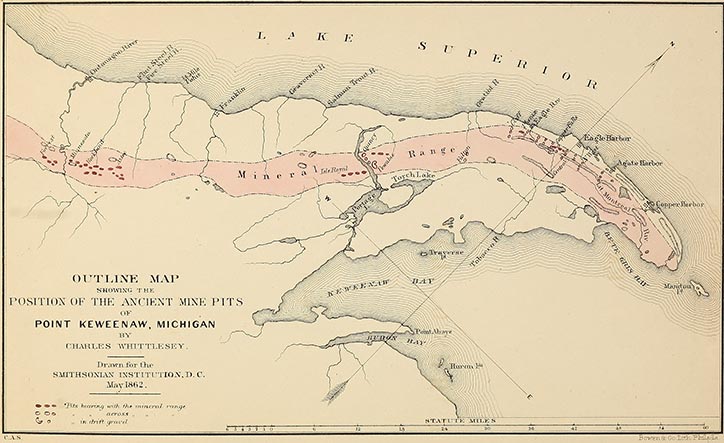
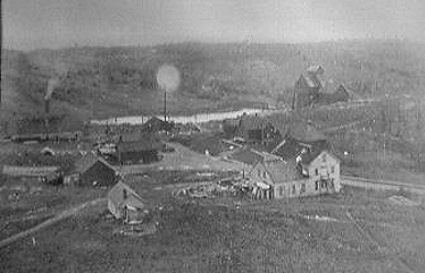
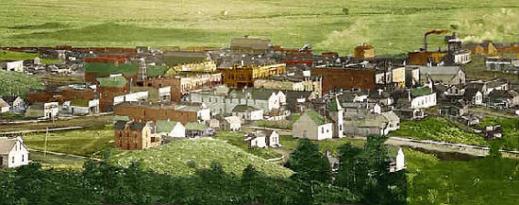
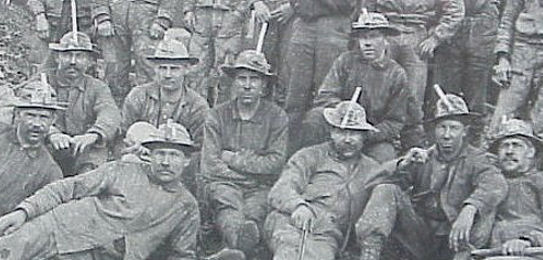
Andrew worked in the copper mine in Ontogogan on Lake Superior. According to Ada, he was present in the mine the day they broke into a chamber and found dead men and some "queer" tools. This may be a reference to the more than a hundred "ancient mines" or artificial caverns discovered in this area.  He was also there when they pulled out the largest piece of solid copper (527 tons) ever taken from the ground (see Minestota Mine). Ontonagon is part of the Keweenawan peninsula where large deposits, "geological freaks," of copper were found.

Miners at Minesota Mine
Map
Ancient Mine Pits

Minesota Mine - productive years,1855-1862
By the time the Civil War started, copper mining was at a "low ebb."  In 1861, Andrew got caught up in the fervor of a patriotic meeting and signed up to join the Michigan Volunteer Infantry. According to Wikipedia, Colonel John C. Robinson recruited volunteers and led the Michigan Volunteer Infantry.  Robinson trained his men in Newport News, Virginia:
John Cleveland Robinson.jpg
John Cleveland Robinson
Robinson was soon sent to Detroit as an army recruiting officer, and for a short time, assisted Governor William Dennison in raising troops in Columbus, Ohio.[2] In September 1861, he was appointed as colonel of the 1st Michigan Volunteer Infantry, a regiment he helped recruit.[2][3] That autumn, he was also promoted to major of the 2nd U.S. Infantry in the regular army, concurrent with his assignment in the volunteer army.[1] Within a few months, he was commanding a brigade of volunteers at Newport News, Virginia in preparation for the Peninsula Campaign.


According to my great grandmother Ada, her father's departure left their family with little means of support and they nearly starved.  Their clothes fell apart when it rained. Andrew's $13 a month barely met their needs.  He began laundering men's shirts at 10 cents each to make extra money, and loaned money "at usurious interest" to other soldiers in order to send money home to his family.  When he became a surgical assistant, he was able to send decent money to his family.

Serving under General McClellan, Andrew took part in the Seven Days march to Richmond, carrying a very heavy case of surgical instruments.  However, he became ill and was hospitalized in New York for six months.  He came home weighing only 85 pounds and was an inch shorter than before he left.  He was too weak to work for a time.

In 1864, Andrew was repairing railroad cars in Marquette.  Ada's dates conflict with the 1870 census. According to the 1870 census, he was living in Delton, near Detroit in the southern part of Michigan, and was working as a watchman at the "furnace." By Ada's account, they lived at the Jackson Furnace in 1867 in the northern part of Michigan, and moved from there to Brainard in 1869, then to Fargo, ND.  Ada wrote that Andrew worked as a bridge builder.  He built the first frame house in Fargo as well as several other buildings in Brainard.
From Fargo: History: "Law and order followed with the arrival of new settlers on the first train of the Northern Pacific to cross the Red River on June of 1872."
Andrew became discouraged by the hard living in Michigan and was beaten by the plague of grasshoppers that destroyed their crops and their homes. In 1875, they heard that the government was going to build a fort near the Black Hills. Settlers were given permission to accompany the army to the Black Hills, so the Halls moved to Fort Lincoln for a time.  During this time, Ada taught school at Fort Lincoln and was present when Custer's men left for the Battle of Little Bighorn in 1876.  According to Ada, who was also a writer and historian, the settlers traveled by wagon train in a long, tightly guarded procession to the Black Hills. Families were cautioned to stay together to be assured of safety.  One couple did not follow this advice and were found dead, scalped by Indians.

They moved around, living in Central City, SD, then Bear Butte Creek.  He received his pension and an inheritance from his father around 1880, so he bought cattle and horses.  By 1886, they had settled on a ranch near Buffalo Gap by the Cheyenne River.  They lived on this ranch for many years.  Young men would come visit and see the girls on the Hall ranch.  "Old Man Hall" was the subject of a little ditty they would sing for him.  In 1890, there was the threat of an Indian uprising because of the "Messiah Craze"*, so men gathered at the Hall ranch for mutual protection.  Horace Crofford was among these men.  Horace and Ada were married the next year.

Andrew HallAndrew and Olivia Hall later moved to Newcastle, Wyoming.  In the days before his death, he deeded his land to Ada (copy of deed can be seen in Ancestry.com).  Andrew is buried in Greenwood Cemetery in Newcastle.


*The U. S. government had seized Lakota lands.  Bison were hunted to near extinction.  Treaties with the Indians were not implemented.  An Indian prophet had a vision of Jesus returning as a Native American and restoring their lands.  The Indians began performing the Ghost Dance, in which they believed they would be protected from the white man's bullets, and that the ghosts of the ancestors would return to earth.  This was referred to by the white people as the "Messiah Craze."  The white men feared this Ghost Dance and believed an uprising was imminent.  An unfortunate series of events led to the Wounded Knee Massacre in South Dakota in 1890.


Wednesday, January 28, 2015

Teresa Marie Allen, part 2

(this post is a continuation of THIS one)

Teresa Marie (nee Ethelyn) Allen
We know that my grandmother, Teresa Allen, nee Ethelyn, was raised in a Catholic boarding school in Paris, Texas.  We know that she was influenced by the nuns who cared for her (we have the Bible that was given to her by one of the Sisters).  She told her daughter Virginia that she changed her name to Teresa, taking on the name of one of the nuns.  We also know that she was trained as a nurse.  In researching the history of Paris, Texas, the only mention of a Catholic boarding school I could find is St. Patrick's, where the nuns were from the order of the Sisters of Mercy, whose mission was nursing. 
The History of Paris Regional Medical Center: Our Paris, Texas acute-care hospital has come a long way since its inception in 1911....The beginning of what was to eventually become Paris Regional dates to 1896 when the Sisters of Mercy operated St. Patrick’s Academy, a boarding school near downtown Paris, Texas. After several years of agonizing labor and severe tests of faith, six sisters reopened the facility as St. Joseph’s Infirmary on October 1, 1911.
http://www.ipernity.com/doc/138242/7266250
St. Joseph's Infirmary, 1908
St. Joseph's Infirmary, Paris, Texas 1916
St. Joseph's, est. 1911, site of St. Patrick's Academy


Present day site of St. Patrick's Academy (from Google Earth)

From Texas to Oklahoma to Illinois Nursing became a licensed profession in the early 1900's in Texas.  A growing percentage of women were in the workforce, and I believe my grandmother was among those at this cultural cutting edge.  In 1920, she was living in Oklahoma City in a boarding house on 11th Street and was working as a nurse.  A fellow roomer in this house was her lifelong best friend Maud Marshall, also a nurse.  The nearest hospital to this location - in walking distance, in fact - is the present-day Oklahoma University Medical Center and College of Nursing.  The Sisters of Mercy were a strong presence in Oklahoma City, as they founded Mount St. Mary Academy, an all girls' school which began as a mission to education Native American children.  From Oklahoma City, my grandmother moved with her friend Maud to Chicago, where there happens to be another Sisters of Mercy hospital. Coincidence?  I think not.  

UPDATE - Found Mother Teresa online!  This story is definitely adding up.
The first Catholic school in Paris was founded by a little band of Sisters of Mercy under the direction of Mother Teresa Muldoon. The sisters arrived in Paris in 1896. For two months, the sisters lived in the old Wooldridge home, at 238 Clarksville Street. With money bequeathed to her by her brother, Mother Teresa purchased three lots adjacent to the church on Clarksville Street. The little school was on the site of the first St. Joseph's Hospital building and now the parking lot west of the present hospital. In four years the sisters had progressed from small shacks to a fine modern building, a combination of a convent, the Convent of Mercy, and a school, St. Patrick's Academy. The school was started with a solemn blessing on March 17, 1900, and included a boarding school for several years. Financial difficulties forced the sisters to close the school, and the sisters converted the school to a hospital in 1910. It was named St. Joseph's Infirmary. They ran it for its first two years. In 1912 the Sisters of Mercy returned to Chicago, and the hospital was then continued under the direction of The Sisters of Charity of the Incarnate Word of San Antonio. Mother Teresa is buried in the Sister's plot in Evergreen Cemetery.
Boston Evening Transcript - Jun 26, 1903


http://glt.amormeus.org/documents/USProvinceNewsletterNovDec07.pdf

Update -Mar 2015:   My sister found a couple of documents packed away with her own nursing school stuff... a listing of licensed nurses in Virginia showing that Teresa Allen Crofford graduated from Paris Sanitarium Training School for Nurses, and a yearbook listing alumni of the school.  She, along with her friend Maude Marshall and five others, comprised the 7th graduating class.  The nursing school originated in the St. Joseph's Infirmary, further cementing the facts in the above story.

Update-June 2015:  searched for Maude Marshall and found her name as well as Teresa Allen's in the City Directories of Sherman Texas, and Paris Texas.  They both worked as nurses at St. Vincent's Sanitarium, and then at the Sanitarium of Paris in 1917-1919.

http://digicol.lib.depaul.edu/cdm/ref/collection/cm1/id/1191


Thursday, January 22, 2015

Horses in the Black Hills

Passing Down a Love of Horses
Lame Johnny Creek was named after a scoundrel who was hanged from a tree near the creek.  The land along this creek was desirable grazing land for ranchers in the Black Hills area.  One ranch on this creek called Fleur de Lys was famed for its horses that were imported from France, including Percheron and Arabian breeds.  My grandfather's family owned horses too.  My grandfather, Horace Crofford, used to talk to me for hours about horses, and I hung on every word.  He described each breed and its characteristics, all of which I remember to this day.  From him, I learned about roans, paints, pacers, mules, Appaloosas, palominos, Percherons, Arabs, quarterhorses, and Tennessee Walkers.  I learned which horses were good for racing, plowing, carriage, or riding, and I could tell you which characteristics made them good for the job. He taught me about halters, bits, and bridles. When I went away to college and visited the riding stable there, I was drawn to a beautiful horse that I could immediately recognize as a Morgan because of Baba's description - barrel chest, strong legs and hindquarters, graceful arched neck, broad forehead, and cupped face.  My identification was confirmed by the owner.

Personal Experience
One story Baba told was about a horse on his father's ranch... during the night, the horse squeezed through the door into the stock room and gorged on oats.  The oats swelled up inside the horse and he couldn't get back out through the door.  The horse raised a ruckus, and the family came running.  They got him out of the storage room somehow, and family members had to take turns walking the horse around and around the paddock all night long so he wouldn't get a ruptured intestine and die.  A drink of water would have killed the horse quickly.

Postcards from my Grandfather
Whenever Baba went to Wyoming to visit his family, he sent postcards of horses and wrote about them on the back:


As you can see, I wore these postcards out studying them!


Thursday, October 2, 2014

Croffords from then to now

1806 Calvin V. Crawford was born in New York.  His Scottish born father, Horace, was known as the "Genesee Valley Millwright."   Milling was a major industry along the Genesee River.  Today, "Crawford" is a recognized name in Rochester.

1815 Anna Dillingham was born in Ohio.  Her family moved to Porter County, Indiana in 1836.  She married Daniel Lyons in 1837 and taught school in her father John Dillingham's home.  The Dillingham name is still important in Liberty and many descendants still live near the old family graves.

                                            Map

1839 Calvin Crawford married Anna in Porter County, Indiana.  He joined the military (Army enlistment states his birthplace as Vermont).  At some point, the spelling of his name changed to Crofford.

1846 Horace Calvin Crofford, the fourth of Calvin and Anna's seven children, was born  (2 of their children died young).

1860 Calvin and Anna moved to Rochester, Missouri, with their children Angeline, Chester, Horace, and Charles, and then moved to Lancaster, Nebraska.

1863 Horace Calvin Crofford was drafted into the cavalry during the Civil War.  His discharge was signed by U. S. Grant.

1864 Calvin Crofford received a Homestead grant of about 154 acres in Lincoln, Nebraska.  His son, Horace Calvin, was one of the witnesses to his settlement in the area, along with Sidney S. Pratt.  They attested that "he has built a house thereon, about 16 + 30 feet with board floor, two doors, and one window. He has since said settlement ploughed and cultivated about 70 acres of said land, and has made the following improvements thereon to wit:  has built a stable for 7 or 8 horses, a grainery and corn crib, dug a well, planted about 500 forest trees, and set out about 80 roads of hedge."  NOTE: this is where the name was first changed from Crawford to Crofford. It was actually crossed off and re-written on the Homestead document. 

1876 Little Big Horn.  Ada Clemina Hall, a school teacher at Fort Lincoln, wrote a paper in defense of Custer.  The Fort was abandoned in 1882.


Fort Lincoln, Dakota Territory

By 1880, Horace Calvin Crofford was working as a quartz miner in Custer County, Dakota Territory.  He married Ada Hall in 1891.  Horace became a respected sheep rancher and county commissioner in Custer.


Horace Calvin Crofford in the late 1800's

1894 Horace and Ada's first child, Horace's namesake, was born in Buffalo Gap, South Dakota.

1895, claiming self defense, Horace killed a young rancher in a dispute over grazing land near Lame Johnny Creek.  He turned himself in to the authorities, and was held by the sheriff at Custer. The family moved to nearby Newcastle, Wyoming, where Ada ran a boarding house to support the family.

Rancher killed


Newcastle about 1905. Wyoming Tales and Trails
Newcastle, Wyoming around 1905
http://www.wyohistory.org/encyclopedia/newcastle-wyoming

1907 Ada's father Andrew Hall signed over to Ada the title to farmland in Weston County (near Newcastle). Horace raised stock and the three boys worked on the farm.  During this period Ada worked on several patented inventions.

My grandfather told lots of stories about life in the west.  One time, a horse broke into the feed storage in the middle of the night and ate a belly full of oats.  The oats swelled and the horse had to be kept moving all night long, everyone taking turns walking him in order to aid digestion and save his life.  

An influential event in my grandfather's life gave birth to a lifelong interest in rocks and fossils.  Near their home in Newcastle, Barnum Brown, a famous paleontologist known as "Mr. Bones," discovered the first documented remains of Tyrannosaurus Rex in 1902.  Family lore is that dinosaur bones were found on the family homestead.       ~Teresa Austin


brown-t-rex-300
Barnum Brown and his Tyrannosaurus Rex

t-rex-skull-250

http://discovermagazine.com/2007/mar/the-bone-collector


1916 Horace died (in Missouri, according to Findagrave.com), leaving Ada dependent on her oldest son, Horace, who was a telegrapher for the railroad.


1917 at the age of 22, Horace enlisted in the army. He was in Normandy during WWI.  He was discharged in 1919.  He was an electronics student at the American Bureau of Engineering (AMBU) Institute in Chicago, which is across the intersection from Mercy Hospital, on Prairie Avenue.  It is possible that this is where he met a nurse, Teresa Marie Allen.

Horace Crofford Engineering School
Horace, 3rd from the right, front row
Teresa Allen
Mercy Hospital, Chicago 1910

AMBU Institute in Chicago, across from Mercy Hospital 

Interesting fact:  Mercy Hospital was named for the Sisters of Mercy.  Teresa lived in a boarding school and was trained as a nurse in Paris, Texas by the Sisters of Mercy at St. Joseph Hospital.  From a history of St. Joseph:  "The origin of St. Joseph's Health System dates to 1896 when the Sisters of Mercy operated a 16-bed hospital in a boarding school near downtown Paris, Texas. But a lack of funds forced the Sisters to give up their mission in 1910."

The Sisters of Mercy also had a hospital in Oklahoma City, where Teresa was working in 1920. The question is, how did she end up moving to Mercy Hospital in Chicago?  Whatever the reason, she probably moved to Chicago, possibly with her friend and fellow nurse, Maud Marshall.  Stay tuned....

Sources:
http://www.encyclopedia.chicagohistory.org/pages/813.html
http://www.christushealth.org/EarlyinCHRISTUSStJosephsHistorySistersStruggletoEstablishParisTexasHospital


In 1921, the Sisters of Mercy took over a World War I Veterans’ Dispensary to offer medical and surgical services to the poor. http://www.mercy-chicago.org/legacy/history


1926 Horace and Teresa married. They moved to West Washington Street, Waukegan, where their children, Horace Calvin "Sonny" and Virginia Maude, were born at St. Therese Hospital.  Sonny and Virginia attended Spaulding Elementary School.  Teresa worked as a nurse at the office of Dr. Jolly, an ear, nose, and throat doctor.  Horace tried his hand in politics but jobs were hard to find after the war.

Horace with Sonny and Virginia
                                                                     
1942  In search of employment, Horace and Teresa moved with their family to Virginia.  Upon their arrival, they lived with friend Ed Suitor in Portsmouth.  Then they moved into a house in Norfolk.  Sonny attended Norview High School.  Virginia graduated from Maury High School in 1950.

Sonny worked all his adult life for the telephone company.  He married Jean Strong; they had four children, Calvin, Ronney, Cindy, and Mark.

1952 Virginia Crofford married John Beverly Zaun.  They had two daughters, Holly and Teresa.  Virginia taught piano, worked as secretary to a prominent and beloved congressman, was the administrative assistant to the Virginia Beach chief of detectives, and finally became Administrative Assistant to the director of city planning. Holly had three children:  Justin, Leah, and Reed Bernick.  Teresa had four sons: Adam, Joshua, Jonathan, and Andrew Austin.

Note: my grandfather Horace, who I called Baba, used to play mouth harp and harmonica, and sing songs like Yellow Rose of Texas, She'll be Comin' Round the Mountain, and Red River Valley.  I see now that those songs are directly out of his experience in the Old West. There is a Red River Valley in Fargo, ND, where his mother grew up, as well as in Paris, TX, where my grandmother Teresa grew up.

Sunday, September 28, 2014

Meeting new cousins

Every now and then, you begin to notice that someone on Ancestry seems to really know what they are doing. They are the ones who read and comment on information posted by others, and who have many documented sources on their family tree. Tim Cole from Porter County, Indiana, commented on one of my Dillingham stories. We started a conversation and here is his message:

timcole: My ggg-grandfather married Sally Dillingham, John's first child by Hannah. I live half a mile away from where John last lived and is buried in front of Olcott's house (still standing). The Coles and Dillinghams bought a section of land each, next to each other, in 1835, and descendants from both families still live on portions of those properties. According to what I can piece together, we are first cousins, several times removed.

Tim urged me to contact a David Dillingham Wiltshire, who is active in researching the Dillingham family and has organized a family group of descendants. So I sent this through Facebook:

Dear David,
Tim Cole urged me to write to you about my Dillingham connection and to request to join your family group. Anna Dillingham of Porter County, Indiana was my 2nd great grandmother. She married Calvin V. Crofford in 1839 (her second marriage). Their son Horace Calvin Crofford m. Ada C. Hall; their son Horace Calvin Crofford was my grandfather. The Croffords ended up in Norfolk, Virginia where my mother grew up. My family and my mother's brother's family still live in the area.

Here is her profile on my family tree in Ancestry:
Anna Dillingham (Lyons)
Your 2nd great grandmother
Birth 29 Sept 1815 in Ohio, USA
Death 13 Apr 1900 in Fall River County, South Dakota, USA

I have traced the Dillingham line back to the 1400's with some degree of confidence. I would be interested in confirming some of my information.

I look forward to hearing from you!

In my ancestry documents is a transcript of the Dillingham family Bible which details births, deaths, and marriages of the Dillinghams.

Sunday, August 31, 2014

Croffords and Dillinghams and the travails of pioneer life

Our story goes back to Calvin V. Crofford, b. 1806.  I have found plentiful documentation on Calvin's life, but nothing about his parentage.  There is family lore about his father (possibly Horace Crofford or Crawford) from Scotland.  Ada Crofford wrote about Horace Crawford settling in the Genessee Valley in NY, who was known as the "Genessee Millwright." Calvin's wife, Anna Dillingham, is easy to trace, though there are questions about the identity of her grandparents.

John Dillingham > Anna Dillingham (m. Calvin Crofford) > Horace C. Crofford > Horace C. Crofford > Virginia M. Crofford > Teresa Zaun Austin

The most important documentation of the Crofford/Dillingham connection is the 1850 census from Porter, Indiana (see below).  It was a thrill to stumble upon the Crofford (Crawford) name while researching the Dillinghams!

The most colorful stories are linked in Ancestry to Anna's father John Dillingham, my 3rd great grandfather.  Here are some highlights:

  • He was born in 1773, in New England (possibly Rhode Island, Connecticut, or Massachusetts - his father's family was from Cape Cod).
  • His mother was a Quakeress.
  • He was a seaman in his youth, once surviving a storm in which the men cast lots to see who would be sacrificed to feed the rest.  Thankfully, they were rescued by another ship near Hartford, CT.
  • At age 21 he married Clarissa Olcott and had six children, all of whom died (two of them in the Fire Lands, part of the western reserve of Connecticut in what is now Ohio).
  • He was enlisted to fight the Indians under General Wayne. He had many hairbreadth escapes from the Indians, as described in the stories.
  • After his discharge, he returned to Connecticut with his little family, but later moved west to Genesee County in New York (until 1809), and then to the area near Cleveland, Ohio. 
  • He married Hannah Hiccox (cousin of Wild Bill) of Cleveland, and had 14 - 15 children, most of whom died at birth. Among them were Sally, Ann, John, Hannah, Betsey, King, Esther, Olcott, and Comfort.
  • John and his son, Henry, served in the War of 1812.  Afterward they worked as mail carriers on the route between Cleveland and General Harrison at Camp Seneca, surviving more close calls with Indians.
  • In 1836, he pioneered by wagon train to Porter Co., Indiana where he died at age 90. 
The descendants of the Dillinghams play an important part in the history of Liberty Township and still populate this ancestral home.  The eastern third of Liberty Township in Porter County was known as the "Dillingham Settlement."  Liberty Township was a quiet and law-abiding community in spite of frequent episodes with Indians, fires, storms, and train wrecks.  John was known for sheltering "wayfaring men" as there was no inn.

Interesting notes:  
1) a history of Liberty Township mentions a "William Crawford" who owned land in the northeast part of the town (Calvin V's relation?).  
2) There is a Crawfordsville, Indiana  (Text, p. 59.) established in 1823 (Wickipedia) and named after Colonel William H. Crawford from Virginia.  Coincidence? I think this is different family, but still...
3) Several sources list John Dillingham as a "Welshman." One source says that John and Hannah were natives of "Wales and Connecticut respectively."I have not found evidence of his Welsh heritage, but it makes me wonder about the accuracy of my research.  
4) Hannah's last name can be spelled many different ways, making research a challenge... Hiccox, Hickok, Hekok, Hitchcock...

The history of Porter Country documents the marriage of Anna Dillingham to Daniel Lyons in 1837 and tells us that Anna taught school in her father's house (eight or nine students).   In 1839, she married Calvin Crawford, who was one of the first settlers of the nearby Jackson Township.  They had five children:  Angeline, Cylinda, Chester, Horace (my great grandfather), and Charles.  Many young men from Liberty fought for the Union in the Civil War (including my great grandfather Horace Crofford).  

1850 Census for Porter, Indiana.  My great grandfather Horace was three years old.

Sunday, May 11, 2014

Ada C. Crofford

My great grandmother, Ada Clemina Hall, was born on July 18, 1856 in Chittenango, New York.

Ada C. Hall > Horace C. Crofford > Virginia M. Crofford > Teresa Zaun Austin

Ada's family (parents, Andrew and Olivia, Ada, and her siblings, Nina and Albert) traveled west and settled in the Dakota Territory sometime before 1876.  Their home was near Bear Butte Creek at the northern edge of the Black Hills (near what is now Sturgis).  Her father was a farmer and her mother kept house, perhaps with her daughter Nina's help.  A young man, Jesse, boarded with them and shared the work of farming.  Albert most certainly worked on the farm as well.  Ada became a teacher.

Ada taught school at Fort Lincoln in North Dakota, and was friends with General Custer's wife, Elizabeth, who was about ten years older than Ada.  Family legend has it that Ada was teaching school at Fort Lincoln on the day that Custer and his men left to fight the Battle of Little Big Horn in May 1876.  Ada later wrote a paper defending General Custer which is now housed in a museum in Newcastle, Wyoming.


"Mrs. Crofford was a school teacher at Ft. Abraham Lincoln and was a friend of General Custer's wife Elizabeth. She came to the Black Hills to teach in 1876." From the obituary of her daughter, Miriam Darrow printed in "Bits and Pieces" Newcastle, Weston, Wyoming, Vol. 4 No. 1, 1968

Ada married Horace C. Crofford in 1891 at age 34. They had three children born in South Dakota - Horace, age 5, Oliver, age 4, and "Abraham" (Abram), age 2.  The census indicates that she had another child that did not survive.  By 1900, they had moved across the line into Wyoming, just south of Newcastle. Daughter Miriam was born in 1902.

Ada holding Miriam, born in 1902.
In 1907, Ada's father Andrew Hall signed over to her the title to farmland in Weston County, in the Newcastle area.  Horace raised stock, and the three boys worked as laborers on the home farm.

Ada was an consummate inventor.  In 1905, she patented a design for an insect trap.  This design has been referenced by other inventors until as recently as 2012.  In 1906, she patented a signal attachment for a life preserver that would make a person in distress visible from a distance.  In 1918, she patented a method for sealing jars of preserves.   In 1923, she patented a mechanism to automatically release the thread tension in a sewing machine.

She was also a writer and historian.  Her story "Pioneer days in North Dakota" was published in the 1923 North Dakota Historical Quarterly.  I wonder if she was inspired by her friendship with "Libbie" Custer who supplemented her widow's pension by writing books about life on the plains.  http://www.kshs.org/kansapedia/elizabeth-bacon-custer/12030

Sunday, March 9, 2014

The Shakespeare of the Netherlands

Joost Van Den Vondel, my maternal 7th great grandfather, was a 16th century poet and playwright who produced some of the greatest works of Dutch literature.  His allegorical plays drew from Christian themes and reflected his religious and political views.  He "holds the record for the longest tradition of annual performance in Europe." (Brill)  John Milton drew inspiration from Vondel's tragedy of Lucifer, introduced in 1654.  You can read the play HERE.   

Joost Van Den Vondel > Joost Van Den Vondel > Johannes Van Den Vondel (Wandell) > Jacob Wandell > Capt. Jacob Wandell > Miriam Olivia Wandell > Ada C. Hall > Horace C. Crofford > Virginia M. Crofford > Teresa Zaun Austin

NOTE: this link has not been verified. Working on it!


From the New Advent Catholic Encyclopedia:  

"He is the greatest poet the Netherlands have produced, one who is distinguished in every form and who occupies a place among the best poets of all time."


As a legacy, Amsterdam's biggest park, the Vondelpark, bears his name, as well as his statue in the northern part of the park. The Dutch five guilder banknote bore Vondel's portrait from 1950 until its discontinuation in 1990.

This connection needs more research.  Ada Hall Crofford shared this family lore in her writings, but the dates don't make sense. 

Saturday, March 8, 2014

Ranchers feud

The story is that my maternal great grandfather Horace Crofford spent a year in jail for murder.  There was a feud over grazing land between the sheep rancher (my great grandfather) and a cattle rancher.  Eventually, it was declared that my great grandfather acted in self defense and he was cleared.

Horace C. Crofford, 1891
I found several newspaper accounts of the incident:
HOT SPRINGS, July 27.—Saturday evening about 7 o'clock a tragedy occurred on Lame Johnny creek, six miles north of Buffalo Gap, in which John Taylor, a young ranchman was shot and instantly killed by Horace Crofford, ex-commissioner of Custer county, and an extensive sheep owner. The trouble arose between the parties over the possession of the range for Crofford's sheep. Crofford immediately gave himself up to the authorities at Buffalo Gap. He will waive examination and be bound over to the circuit court. Public sympathy seems to be with Crofford, who, it is claimed, did the killing In self defense. Crofford is in charge of the sheriff at Custer. Estherville Daily News, 1895
1.  The small town of Buffalo Gap.  2. the fertile land about six miles north of Buffalo Gap on Lame Johnny Creek.  I studied the maps of the area and best I can figure, this is the approximate site of the killing.  Area is at the southern end of the Black Hills National Forest, near Custer State Park.

I have not found documentation of the resolution of the case. 

Sunday, March 2, 2014

We will never be Royals

... but we were so close!  the English are so much better at documenting their lineages.  Once I am able to connect our family tree to someone in England, the research is a piece of cake.  There are Knights, Lords and Ladies, Crusaders, Consorts, Castles, and a direct (albeit illegitimate) link to Royalty in our ancestry. There was even a beheading!

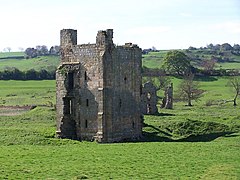
Elizabeth Fitzhugh Vaux, Lady of Ravensworth, my 14th great grandmother on my paternal side, was the grandmother of Catherine Parr, the sixth wife of Henry VIII.  The Vaux family were created barons by Henry VIII in 1523.
Ravensworth Castle - geograph.org.uk - 2380905.jpg
Ruins of Ravensworth Castle
Her husband Nicholas, my paternal 14th great grandfather, was the Baron of Harrowden; his grandfather was a Knight.

Harrowden Hall, now the Wellingborough Golf Club

Sir George Throckmorton, my paternal 13th great grandfather, was the Lord and Knight of Coughton.
His son, Sir Robert, was the High Sheriff of Warwick.

My paternal 12th great grandmother was Muriel Berkeley of Berkeley Castle.

Berkeley Castle

Audrey Barlow, my paternal 9th great grandmother, was a descendent of Henry II of England by his mistress Ida De Tony.
scan0003-Elizabeth Audrey Barlowe
Audrey Barlow, also the ancestor of Sarah Palin, Richard Nixon, and Jimmy Carter.

My maternal 14th great grandfather, Sir Ieuan "Evan" Bushe, was descended from Welsh royalty and was in a long line of Knights and Ladies, and his issue married into families of Lords and Ladies such as Fernfould and L'Strange. According to Wikipedia, he was a renowned poet.
Ieuan wrote about 50 poems.  His love poems are considered to be his best work.

Sir William Carter of Hertfordshire, my maternal 13th great grandfather, married Lady Alice Croxton of Watford; his parents were the Lord and Lady of Cusworth.
File:Cusworth Hall.jpg
Cusworth Hall, now a country house museum
Lord William Ravenscroft of Croxton (maternal 14th great grandfather), father of Lady Alice.
Croxton Abbey

My maternal 16th great grandfather, Richard Neville, Earl of Salisbury, was beheaded in 1460 after the Battle of Wakefield.
Richard Neville effigy

Others direct ancestors include:
Sir John Anstell (maternal 13th great grandfather) of Cornwall

Cornwall
Sir John Wright, maternal 15th great grandfather, Lord Kelvedon
St. Mary the Virgin Church, Kelvedon, Essex
Perhaps, most famously of all, John Plantagenet, 1st Duke of Lancaster, maternal 18th great grandfather
Johnofgaunt.jpg
John of "Gaunt" (born in Ghent), 1st Duke of Lancaster
Kenilworth Castle, modernized by John of Gaunt after 1350.

So, that is the extent of my knowledge of our English bloodlines to date.  I remember learning about some of these people in my history and English Literature classes.